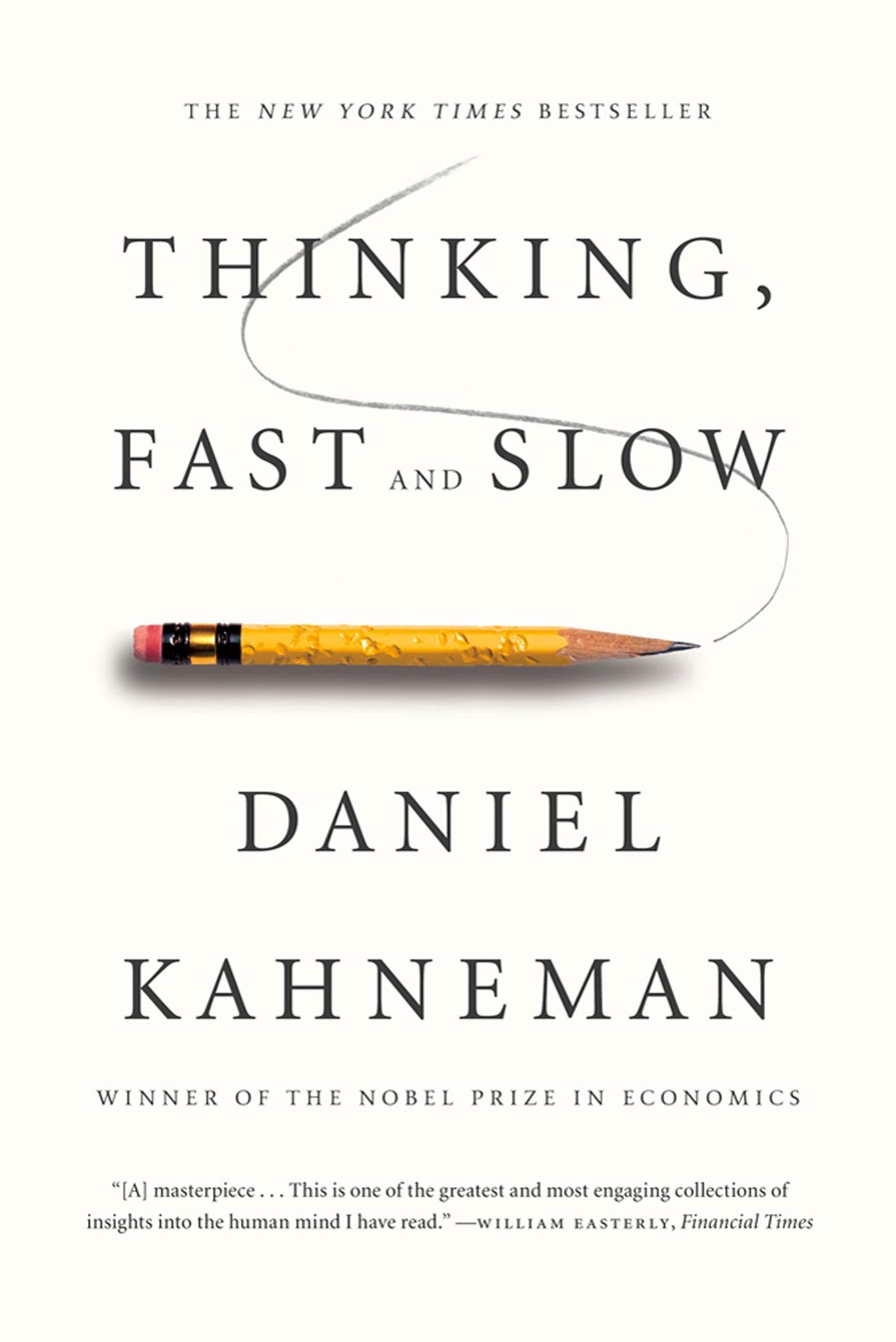
Thinking, Fast and Slow
by Daniel Kahneman
Book Details
Categories
"Nothing in life is as important as you think it is, while you are thinking about it."— Daniel Kahneman
Kahneman’s masterpiece offers profound insights into the dual systems that govern human thinking: the fast, intuitive System 1 and the slow, deliberate System 2. This book has fundamentally changed how I approach decision-making both in leadership and software development.
The Two Systems
System 1 (Fast Thinking): Automatic, intuitive, emotional. This system handles routine tasks and quick judgments but is prone to biases and errors.
System 2 (Slow Thinking): Deliberate, logical, effortful. This system is activated for complex problems and conscious decision-making.
Understanding this distinction has been invaluable in my role as Head of Engineering, particularly when making strategic decisions or working with team dynamics.
Key Takeaways for Leaders
Cognitive Biases: The book catalogues numerous cognitive biases that affect decision-making. The availability heuristic, confirmation bias, and anchoring effect are particularly relevant in technical leadership.
Overconfidence: Kahneman’s exploration of overconfidence has made me more cautious about technical estimates and project timelines. We consistently underestimate complexity and overestimate our abilities.
Loss Aversion: The principle that losses loom larger than gains has shaped how I approach change management and team motivation.
Applications in Software Development
The concepts translate remarkably well to software development:
- Code Reviews: Understanding cognitive biases helps create more effective review processes
- Estimation: Recognizing the planning fallacy improves project estimation
- User Experience: System 1 thinking informs intuitive interface design
- Risk Assessment: Probability neglect awareness improves architecture decisions
Leadership Implications
As a leader, understanding these cognitive patterns helps in:
- Team Dynamics: Recognizing when team members are operating from System 1 vs System 2
- Decision Architecture: Structuring decisions to minimize bias
- Change Management: Accounting for loss aversion when implementing new processes
- Performance Reviews: Understanding the halo effect and other evaluation biases
Critiques
While groundbreaking, the book can be dense and repetitive. Some findings from the replication crisis in psychology have questioned specific studies, but the core insights remain solid.
Final Reflections
This book is essential reading for anyone in leadership positions. It provides a framework for understanding not just how we think, but how we can think better. The insights are particularly valuable in our field, where technical decisions often have far-reaching consequences.
The book has made me a more thoughtful leader and decision-maker, always asking: “Which system am I using right now, and is it the right one for this situation?”